

From AI as a Tool to AI as Part of the Organisation
Every morning over coffee, I spend some time looking through what has changed in artificial intelligence during the previous day: new models, agents, infrastructure releases, regulatory developments and, increasingly, examples of AI moving into real operating environments.
Until recently, most of these developments could still be described as improvements. Models became more capable, context windows became larger, AI learned to work with more tools, interfaces became more convenient and the cost of intelligence continued to fall.
Over the past few weeks, however, I have found that description increasingly inadequate. Viewed separately, the announcements still look incremental. Viewed together, they point to a shift of a different order. The components of a new type of organisation are beginning to appear at the same time.
My expectation is that in 2027 Dubai will begin registering a new generation of AI-native solo-founder companies. Legally, many of them may initially look like perfectly conventional companies with one human shareholder or founder. Operationally, however, they will be fundamentally different:
- One human founder
- A persistent corporate memory
- A machine-readable management layer
- Specialised AI agents
- Clearly defined permissions and approval thresholds
- An increasingly autonomous operating system that carries a substantial share of administration, coordination, analysis and management
There does not necessarily have to be a new legal category called an “AI company” before this happens. The important shift can take place inside the operating architecture of an existing legal entity. The novelty will not initially be in the cap table. It will be in how the company actually works.
The evidence is already visible
The strongest evidence for this shift is not another impressive chatbot demonstration. It is the fact that AI is beginning to acquire a permanent place inside operating systems.
The UAE provides an unusually clear example. In September, the UAE Cabinet approved the launch of the Cabinet AI Advisor system, built around 32 specialised AI advisers designed to analyse policies, legislation and strategies, assess the potential impact of decisions, compare international practice and support implementation. Human judgement remains with ministers, but AI is no longer sitting outside the organisation waiting for somebody to ask a question. It is being assigned a defined place inside an institutional process.
That distinction matters. The same transition is beginning to become technically possible inside private companies. New agent infrastructure is being designed for AI systems that can retain context, use tools, coordinate other agents, work with files and software, and continue operating over long periods rather than for the duration of a single chat session.
Individually, these still look like product releases. Collectively, they begin to remove one of the structural limitations that has defined companies since the arrival of business software: software no longer has to remain passive until a human operator manually moves every process to the next stage.
The Founder Will Need a Digital Management Layer
Many founders already know the opposite condition very well. A company may have dozens of software products, several teams and increasingly sophisticated AI tools, but somewhere in the middle there is still one person who understands the context and connects the pieces.
- Research comes from one system
- Documents live in another
- Communication happens through email and messengers
- Tasks are stored elsewhere
- Decisions wait for approval, while information has to be repeatedly moved from one environment into another
The founder becomes the integration layer. In technology, an API allows different systems to communicate. In many businesses today, the founder is effectively the human API between projects, systems, people and decisions.
AI-native architecture changes that role. I increasingly think that the human layer of such a company may become surprisingly small, but also more important. The founder remains responsible for vision, direction, values, taste, relationships, risk and final judgement. What begins to change is the amount of management logic that can be made explicit.
This is where the idea of a digital management twin becomes more interesting than the familiar media avatar. A useful management twin does not need to look like the founder or speak with the founder’s voice. Its purpose is to represent how the founder actually manages:
- What are the priorities of the company?
- How does the founder evaluate risk?
- Which decisions can be delegated? Which situations require escalation?
- What information is capable of changing a decision?
- Which commercial, ethical or financial boundaries must never be crossed?
- How should competing priorities be resolved?
Once those rules, preferences and decision patterns become explicit, they can become part of the company’s operating architecture. The founder does not disappear. The founder stops having to personally answer the same operational question for the hundredth time.
The Company Will Need Its Own Memory
A sophisticated operating layer cannot be built around a language model alone. Intelligence without organisational context is not management.
The next component is what I think of as Company Memory. Most organisations already possess huge amounts of institutional knowledge, but that knowledge is fragmented across CRM systems, email, financial software, documents, databases, meeting notes and, most dangerously, the memories of individual employees.
A genuine Company Memory would combine not only raw data, but also the history of decisions, relationships, operating rules, accumulated experience, current priorities and the present state of the organisation. That context would be continuously available to authorised AI systems.
This matters because an agent that understands only the immediate task is still fundamentally a tool. An agent that understands what the company knows, what it has decided before, what it is trying to achieve and what it is permitted to do begins to occupy a different place inside the organisation. The company itself becomes machine-readable.
From the Automated Workplace to the Automated Enterprise
There is a historical analogy that I find useful. In Soviet computing, the term automated workplace, or АРМ, referred to a software-and-hardware complex designed to automate a specific type of professional activity. At the time, the unit of automation was the workplace.
What is changing now is the scale of that idea. Instead of creating an automated environment around one specialist, it is becoming possible to create an intelligent operating environment around the company itself.
Different agents can be responsible for research, financial analysis, operations, marketing, publishing, customer communication, internal control or software development. They receive context from Company Memory, use internal and external tools, interact with the internet and company systems, execute tasks, verify results and return new information to the common knowledge layer. When a decision crosses an agreed boundary, the system escalates it to the founder or another responsible human.
The operating cycle therefore begins to look less like a chain of employees manually passing information to one another and more like a continuous system:
Understand, research, decide within authority, execute, verify, record, learn and escalate when necessary.
Taken together, the digital management twin, Company Memory, specialised agents, company data, operating algorithms, tools and permissions form what I would describe as an AI exoskeleton around the company. This is not another assistant. It is an operating layer.
The Next Step Is Economic Agency
A company does not only analyse information. It buys services, enters agreements, allocates resources, makes payments and sells products. That part of the architecture is also beginning to change. Agentic systems are moving towards environments in which software can not only recommend an action, but, within predefined financial and legal limits, initiate it.
The difference is substantial. Today a typical business process may involve software identifying a problem, a human reviewing it, another employee finding a supplier, a manager approving the expense, another system making the payment and somebody finally recording the result.
In a more autonomous structure, an authorised agent can:
- Identify the requirement
- Access the appropriate corporate context
- Research possible solutions
- Evaluate them using predefined rules
- Prepare or initiate the approved transaction
- Verify the result
- Write what happened back into Company Memory
Human intervention is reserved for situations where responsibility, regulation, judgement or a defined threshold requires it. At that point autonomy is no longer a feature inside the company. It becomes one of the properties of the company itself.
Why I Expect the First Wave in Dubai
Dubai is not the only place where these technologies can be assembled, but it is one of the few places where government ambition, digital infrastructure, capital, company formation, regulation and a willingness to experiment are moving in the same direction.
- The UAE has made AI transformation part of national policy
- Dubai has been building specialised infrastructure for AI companies, talent and investment
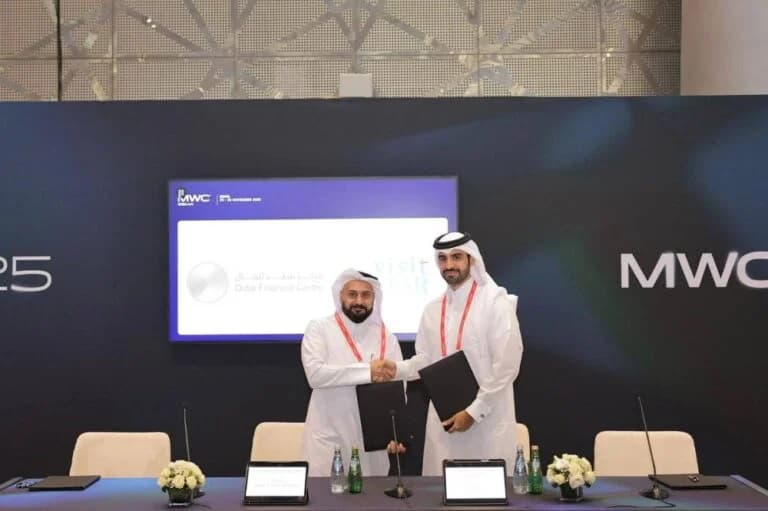
- DIFC has gone further by publicly stating its ambition to become the world’s first AI-native financial centre, with AI embedded not only in individual products but in legal frameworks, the business environment, talent development and ecosystem infrastructure
- The UAE government itself is simultaneously experimenting with agentic operating models
This combination is important because a genuinely AI-native company requires more than access to a good model. It requires an environment in which technology, data, regulation, payments, company formation, capital and expertise can interact. Dubai is increasingly becoming such an environment.
And this is why I believe the important AI story of 2027 will not be that one model became another 20 or 30 per cent better on a benchmark. The bigger story will be the appearance of companies that could not have been economically or operationally built in their present form only two years earlier.
They may have one human founder and perhaps a very small human team. But surrounding that founder will be a persistent Company Memory, a digital management twin, specialised autonomous agents, access to internal and external data, company-specific operating algorithms, defined authority levels and an AI exoskeleton carrying a substantial part of the daily operating cycle.
Legally, the founder will remain human. Responsibility will remain human. Strategic direction and final judgement will remain human. Operationally, however, this will be a different form of enterprise.
The 2027 Prediction
My prediction is specific:
In 2027, Dubai will begin registering AI-native solo-founder companies whose operating architecture is built from the outset around Company Memory, a digital management layer, autonomous AI agents and a defined human approval and responsibility system.
The first versions may still be incorporated under existing company structures. Later, regulation and terminology may evolve as the operating model becomes more common.
But I do not think we need to wait for the terminology before building the company. I intend to be the first founder to submit an application in Dubai for a company explicitly designed and presented as an AI-native solo-founder enterprise. Whether the regulator ultimately calls it an AI-native company, autonomous enterprise or something else is secondary. The shift itself is already becoming visible. By the time we agree on the name, the first companies will already be operating.